
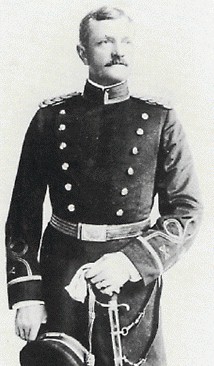
John J. Pershing
General of the Armies John Joseph Pershing (September 13, 1860 – July 15, 1948), nicknamed "Black Jack", was an American army general, educator, and founder of the Pershing Rifles. He served as the commander of the American Expeditionary Forces (AEF) during World War I from 1917 to 1920. In addition to leading the AEF to victory in World War I, Pershing served as a mentor to many in the generation of generals who led the United States Army during World War II, including George C. Marshall, Dwight D. Eisenhower, Omar Bradley, Lesley J. McNair, George S. Patton, and Douglas MacArthur. During his command in World War I, Pershing resisted British and French demands that American forces be integrated with their armies, essentially as replacement units, and insisted that the AEF would operate as a single unit under his command, although some American units fought under British and Australian command, notably in the Battle of Hamel and the breaching of the Hindenburg Line at St Quentin Canal, precipitating the final German collapse. Pershing also allowed (at that time segregated) American all-Black units to be integrated with the French Army. Pershing's soldiers first saw serious battle at Cantigny, Chateau-Thierry, and Belleau Wood on June 1–26, 1918, and Soissons on July 18–22, 1918. To speed up the arrival of American troops, they embarked for France leaving heavy equipment behind, and used British and French tanks, artillery, airplanes and other munitions. In September 1918 at St. Mihiel, the First Army was directly under Pershing's command; it overwhelmed the salient – the encroachment into Allied territory – that the German Army had held for three years. For the Meuse-Argonne Offensive, Pershing shifted roughly 600,000 American soldiers to the heavily defended forests of the Argonne, keeping his divisions engaged in hard fighting for 47 days, alongside the French. The Allied Hundred Days Offensive, of which the Argonne fighting was part, contributed to Germany calling for an armistice. Pershing was of the opinion that the war should continue and that all of Germany should be occupied in an effort to permanently destroy German militarism. Pershing is the only American to be promoted in his own lifetime to General of the Armies, the highest possible rank in the United States Army. Allowed to select his own insignia, Pershing chose to continue using four stars in either silver or gold. Some of his tactics have been criticized both by other commanders at the time and by modern historians. His reliance on costly frontal assaults, long after other Allied armies had abandoned such tactics, has been blamed for causing unnecessarily high American casualties. Pershing was also criticized by some historians for his actions on the day of armistice as the commander of the American Expeditionary Force. Pershing did not approve of the armistice, and despite knowing of the imminent ceasefire, he did not tell his commanders to suspend any new offensive actions or assaults in the final few hours of the war. In total, there were nearly 11,000 casualties (3,500 American), dead, missing, or injured during November 11, the final day of the war, which exceeded the D-Day casualty counts of June 1944. For instance, allied casualties on the first day of the D-Day invasion were 4,414 confirmed dead. Pershing and several subordinates were later questioned by Congress; Pershing maintained that he had followed the orders of his superior, Ferdinand Foch; Congress found that no one was culpable. |
Birth and Death Data: Born Laclede (city in Linn County, Missouri, United States), Died July 15, 1948 (Washington, D.C. (capital city of the United States of America) )
Date Range of DAHR Recordings: 1918
Roles Represented in DAHR: speaker
 = Recordings are available for online listening.
 = Recordings were issued from this master. No recordings issued from other masters.
Recordings
| Company | Matrix No. | Size | First Recording Date | Title | Primary Performer | Description | Role | Audio |
|---|---|---|---|---|---|---|---|---|
| Columbia | 77953 | 10-in. | 7/16/1918 | From the battlefield of France | John J. Pershing | Speech | speaker | |
| Columbia | 69333 | 10-in. | March 1918 | From the battlefields of France | John J. Pershing | Speech | speaker |
Citation
Discography of American Historical Recordings, s.v. "Pershing, John J.," accessed December 24, 2025, http://adp.library.ucsb.edu/names/101902.
Pershing, John J.. (2025). In Discography of American Historical Recordings. Retrieved December 24, 2025, from http://adp.library.ucsb.edu/names/101902.
"Pershing, John J.." Discography of American Historical Recordings. UC Santa Barbara Library, 2025. Web. 24 December 2025.
DAHR Persistent Identifier
External Sources
Wikipedia: John J. Pershing
Discogs: John J. Pershing
RILM: John J. Pershing
IMDb: John J. Pershing
Britannica: John J. Pershing
Linked Open Data Sources
LCNAR: Pershing, John J. (John Joseph), 1860-1948 - https://id.loc.gov/authorities/names/n50009048
Wikidata: John J. Pershing - https://www.wikidata.org/entity/Q272383
VIAF: https://viaf.org/viaf/24713721
MusicBrainz: John J. Pershing - https://musicbrainz.org/artist/f145b0a9-d8f7-4298-9bac-c9a9a15e73a9
Fast: https://id.worldcat.org/fast/2572 - https://id.worldcat.org/fast/2572
Wikipedia content provided under the terms of the Creative Commons BY-SA license
Feedback
Send the Editors a message about this record.