
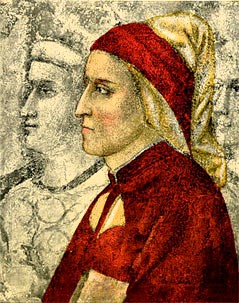
Dante Alighieri
Dante Alighieri (Italian: [ˈdante aliˈɡjɛːri]; most likely baptized Durante di Alighiero degli Alighieri; c. May 1265 – September 14, 1321), widely known mononymously as Dante, was an Italian poet, writer, and philosopher. His Divine Comedy, originally called Comedìa (modern Italian: Commedia) and later christened Divina by Giovanni Boccaccio, is widely considered one of the most important poems of the Middle Ages and the greatest literary work in the Italian language. At a time when Latin was still the dominant language for scholarly and literary writing—and when many Italian poets drew inspiration from French or Provençal traditions—Dante broke with both by writing in the vernacular, specifically his native Tuscan dialect. His De vulgari eloquentia (On Eloquence in the Vernacular) was one of the first scholarly defenses of the vernacular. His use of the Florentine dialect for works such as The New Life (1295) and Divine Comedy helped establish the modern-day standardized Italian language. His work set a precedent that important Italian writers such as Petrarch and Boccaccio would later follow. Dante was instrumental in establishing the literature of Italy, and is considered to be among the country's national poets and the Western world's greatest literary icons. His depictions of Hell, Purgatory, and Heaven provided inspiration for the larger body of Western art and literature. He influenced English writers such as Geoffrey Chaucer, John Milton, and Alfred Tennyson, among many others. In addition, the first use of the interlocking three-line rhyme scheme, or the terza rima, is attributed to him. He is described as the "father" of the Italian language, and in Italy he is often referred to as il Sommo Poeta ("the Supreme Poet"). Dante, Petrarch, and Boccaccio are also called the tre corone ("three crowns") of Italian literature. |
Birth and Death Data: Born Florence (Italian city and commune, located in Tuscany), Died September 22, 1321 (Ravenna (city in northern Italy) )
Date Range of DAHR Recordings: 1899 - 1930
Roles Represented in DAHR: author
 = Recordings are available for online listening.
 = Recordings were issued from this master. No recordings issued from other masters.
Recordings
| Company | Matrix No. | Size | First Recording Date | Title | Primary Performer | Description | Role | Audio |
|---|---|---|---|---|---|---|---|---|
| Berliner | 1198 | 7-in. | Before April 1899 | Il conte regolino | Ferruccio Giannini | Recitation | author | |
| Brunswick | IC4464 | 16-in. | 4/30/1930 | Dante’s inferno | J. F. Carson | Recitation | author | |
| Brunswick | IC4465 | 16-in. | 4/30/1930 | Dante’s inferno | J. F. Carson | Recitation | author | |
| Brunswick | IC4466 | 16-in. | 4/30/1930 | Dante’s inferno | J. F. Carson | Recitation | author | |
| Brunswick | IC4467 | 16-in. | 4/30/1930 | Dante’s inferno | J. F. Carson | Recitation | author | |
| Brunswick | IC4468 | 16-in. | 4/30/1930 | Dante’s inferno | J. F. Carson | Recitation | author | |
| Brunswick | IC4469 | 16-in. | 4/30/1930 | Dante’s inferno | J. F. Carson | Recitation | author |
Citation
Discography of American Historical Recordings, s.v. "Alighieri, Dante," accessed December 24, 2025, http://adp.library.ucsb.edu/names/102260.
Alighieri, Dante. (2025). In Discography of American Historical Recordings. Retrieved December 24, 2025, from http://adp.library.ucsb.edu/names/102260.
"Alighieri, Dante." Discography of American Historical Recordings. UC Santa Barbara Library, 2025. Web. 24 December 2025.
DAHR Persistent Identifier
External Sources
Wikipedia: Dante Alighieri
Discogs: Dante Alighieri
Allmusic: Dante Alighieri
Grove: Dante Alighieri
IMSLP: Dante Alighieri
RILM: Dante Alighieri
RISM: Dante Alighieri
IMDb: Dante Alighieri
Britannica: Dante Alighieri
Linked Open Data Sources
LCNAR: Dante Alighieri, 1265-1321 - https://id.loc.gov/authorities/names/n78095495
Wikidata: Dante Alighieri - https://www.wikidata.org/entity/Q1067
VIAF: https://viaf.org/viaf/97105654
MusicBrainz: Dante Alighieri - https://musicbrainz.org/artist/6c5a8114-cc72-43bc-a741-00756b317e0e
Getty ULAN: Alighieri, Dante - https://vocab.getty.edu/ulan/500265888
Fast: https://id.worldcat.org/fast/29097 - https://id.worldcat.org/fast/29097
Wikipedia content provided under the terms of the Creative Commons BY-SA license
Feedback
Send the Editors a message about this record.