
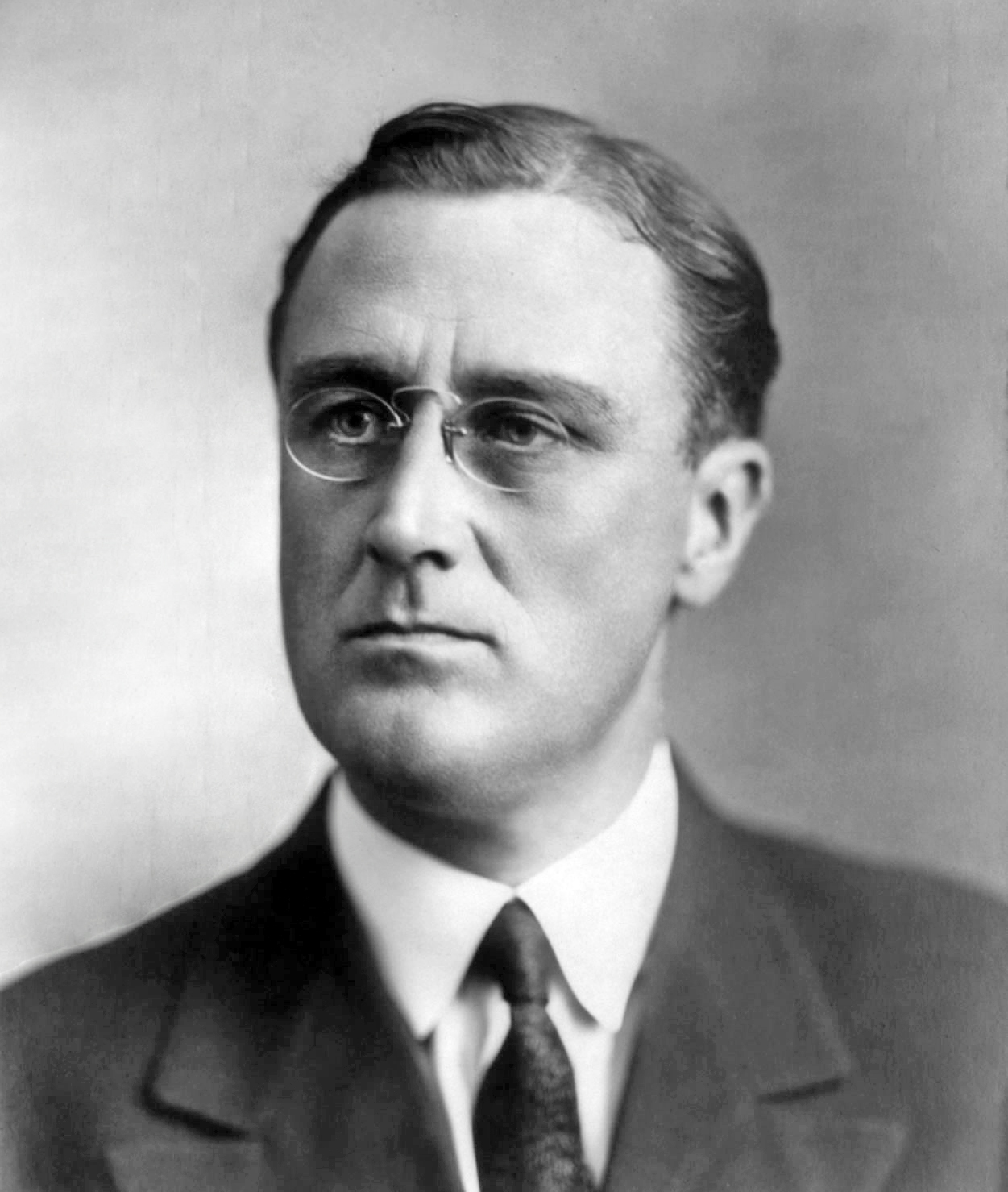
Louis M. Howe
Louis McHenry Howe (January 14, 1871 – April 18, 1936) was an American reporter for the New York Herald best known for acting as an early political advisor (1909–1936) to future 32nd President Franklin D. Roosevelt (1882–1945, served 1933–1945). Born to a wealthy family in Indianapolis, Indiana, Howe was a small, sickly, and asthmatic child. After serious financial losses, the family moved northeast to Saratoga Springs, New York. Howe married Grace Hartley and became a journalist with a small newspaper that his father purchased. He spent the next decade freelancing for the larger, more prominent New York Herald in New York City and working various jobs. In 1906 Howe was assigned to cover the New York state legislature, and soon became a political operative for Thomas Mott Osborne, a Democratic Party opponent of the dominant Tammany Hall political machine in New York City and state. After Osborne fired Howe in 1909, Howe attached himself to rising young Democratic star Franklin D. Roosevelt (1882–1945), with whom he worked for the rest of his life. Howe oversaw Roosevelt's campaign for the New York State Senate, worked with him in the U.S. Navy Department when FDR was Assistant Secretary of the Navy during the First World War era in the presidential administration of 28th President Woodrow Wilson (1854-1924, served 1913-1921). Howe subsequently acted as an advisor and campaign manager during young Roosevelt's 1920 vice presidential election campaign run. After Roosevelt contracted polio in 1921, resulting in partial paralysis, Howe became Roosevelt's public representative, keeping his political career alive during his gradual semi-recovery (although never regaining full use of his legs, wearing heavy steel braces and needing assistance to walk short distances). He arranged Roosevelt's 1924 "Happy Warrior" inspiring speech at the 1924 Democratic National Convention that returned him to the public eye, and four years later helped to run Roosevelt's narrowly successful 1928 campaign to become Governor of New York in the state capital of Albany. Howe then spent the next four years laying the groundwork for Roosevelt's campaign and presence at the 1932 Democratic National Convention in Chicago, where he secured the Democratic Party's nomination and subsequent landslide 1932 presidential election victory, during the deepest darkest years of the economic hardships and mass unemployment of the Great Depression of the 1930s. Named President Roosevelt's secretary, Howe helped the 32nd president to shape the early programs of the New Deal theme for the administration, particularly the Civilian Conservation Corps (C.C.C.). Howe however grew ill shortly after Roosevelt's election, and died before the end of his first term in 1936, and was not able to lend much advice or assistance in FDR's reelection campaign for a second term in the greater landslide victory of the 1936 U.S. elections. Howe also acted as a political advisor to Franklin's wife, Eleanor, and he encouraged her to take an active role in politics, introducing her to women's groups and coaching her in public speaking. Eleanor later called Howe one of the most influential people in her life. Franklin Roosevelt biographer Jean Edward Smith called Howe "a backroom man without equal in Democratic politics", and Roosevelt publicly credited Howe and James Farley for his first election to the presidency in 1932. |
Birth and Death Data: Born Indianapolis (capital city of the U.S. state of Indiana and the seat of Marion County), Died April 18, 1936 (Bethesda (unincorporated community in Montgomery County, Maryland, United States) )
Date Range of DAHR Recordings: 1933
Roles Represented in DAHR: speaker
Notes: Secretary and adviser to Franklin D. Roosevelt.
 = Recordings are available for online listening.
 = Recordings were issued from this master. No recordings issued from other masters.
Recordings
| Company | Matrix No. | Size | First Recording Date | Title | Primary Performer | Description | Role | Audio |
|---|---|---|---|---|---|---|---|---|
| Victor | MS-76364 | 16-in. | 5/31/1933 | The progress of radio | Elmer Tiling Cunningham ; Louis M. Howe | Radio broadcast : Promotional talks | speaker | |
| Victor | MS-76365 | 16-in. | 5/31/1933 | The progress of radio | Unidentified speaker(s) (Victor Records) | Radio broadcast : Promotional talks | speaker | |
| Victor | MS-76366 | 16-in. | 5/31/1933 | The progress of radio | Elmer Tiling Cunningham ; Louis M. Howe | Radio broadcast : Promotional talks | speaker | |
| Victor | MS-76367 | 16-in. | 5/31/1933 | The progress of radio | Elmer Tiling Cunningham ; Louis M. Howe | Radio broadcast : Promotional talks | speaker | |
| Victor | MS-76378 | 16-in. | 6/4/1933 | National affairs | Col. L. M. Howe ; Walter Trumbull | Radio broadcast : Interview | speaker |
Citation
Discography of American Historical Recordings, s.v. "Howe, Louis M.," accessed December 25, 2025, http://adp.library.ucsb.edu/names/106065.
Howe, Louis M.. (2025). In Discography of American Historical Recordings. Retrieved December 25, 2025, from http://adp.library.ucsb.edu/names/106065.
"Howe, Louis M.." Discography of American Historical Recordings. UC Santa Barbara Library, 2025. Web. 25 December 2025.
DAHR Persistent Identifier
Linked Open Data Sources
LCNAR: Howe, Louis M. (Louis McHenry), 1871-1936 - https://id.loc.gov/authorities/names/n89118383
Wikidata: Louis Howe - https://www.wikidata.org/entity/Q3262681
VIAF: https://viaf.org/viaf/54365187
Fast: https://id.worldcat.org/fast/266067 - https://id.worldcat.org/fast/266067
Wikipedia content provided under the terms of the Creative Commons BY-SA license
Feedback
Send the Editors a message about this record.